


Villain Hitting for Vicious Little Nobodies by Lindsay Wong
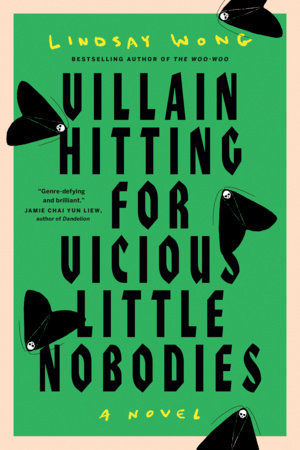
Reviewed by Wayne Ng
Many writers begin with the premise that families are complicated and surviving trauma is a lifelong odyssey. Lindsay Wong’s Villain Hitting for Vicious Little Nobodies makes that maxim seem quaint. Her latest novel is one of the boldest and most original Canadian works in recent memory: a grotesque, darkly funny, emotionally intelligent book that fuses immigrant family saga, savage social satire, supernatural folklore, historical reckoning, and body horror into something wholly and uniquely its own. It is the kind of novel that risks alienating unsuspecting readers expecting convention, while thrilling anyone hungry for fiction that refuses to behave.
Wong writes with the manic confidence of an author unconcerned with respectability politics or market neatness. The result is a novel that feels genuinely dangerous in the best literary sense: excessive, emotionally volatile, formally unruly, and gloriously unwilling to soften its sharpest edges.
Wong announces her intentions immediately with one of the sharpest opening premises in recent fiction. Locinda Lo, lonely, penniless, desperate, and increasingly convinced no living man will ever choose her, signs up for corpse briding—a matchmaking service that arranges marriage between the living and the dead. It is absurd, hilarious, and emotionally devastating all at once. Beneath the comic grotesquerie lies a brutal truth: Locinda would rather be chosen by a corpse than ignored by the living. In that single concept, Wong skewers beauty culture, marriage markets, filial pressure, class anxiety, and the humiliations of female desirability politics.
Locinda and her sister Samantha are raised inside the bizarre family trade of “Villain Hitting”—a curse-for-hire business run out of cramped Chinatown apartments, where betrayals, jealousies, bad bosses, cheating lovers, and petty grievances are transformed into ritual vengeance. Their grandmother, Mah Mah, is both an entrepreneur and a philosopher, schooling them in the harsh economics of survival, the uses of bitterness, and the dangers of a world that devours the soft. As the sisters grow into adulthood, rivalry, hunger, beauty, class aspiration, and inherited cruelty begin to warp their bond. Interwoven through their story is the harrowing history of their grandmother, aka Baozhai in wartime Hong Kong, whose suffering under Japanese occupation reveals the deeper origins of the family’s strange moral code.
That summary doesn’t begin to capture how bizarre, funny, and ferocious this novel is. Wong’s greatest strength is her refusal to reduce immigrant life into the usual sentimental templates of sacrifice and gratitude. Here, survival is ugly, improvisational, vulgar, cunning, and often hilarious. Mah Mah’s worldview—where generosity is a liability and bitterness can be productive capital—is both absurd and disturbingly coherent. Wong understands that trauma often survives not as a burden, but as behaviour: gossip, comparison, hoarding, manipulation, obsession with appearance, emotional gamesmanship, family score-settling. Historical violence does not disappear—it miniaturizes itself into household habits.
The Locinda/Samantha dynamic is especially sharp. Samantha, dead yet resurrected and socially magnetic, funny, sensual, and ravenous for attention, becomes both sister and rival, object of envy and impossible standard. Locinda, meanwhile, is one of the more compelling protagonists I’ve encountered lately: resentful, observant, yearning, vain, needy, frequently unlikeable, and painfully human. Her refusal to accept second place—socially, emotionally, spiritually—drives much of the novel’s energy. Wong understands that shame and envy are narratively potent, and she mines them brilliantly. Few writers are willing to make female ambition and emotional ugliness this naked without eventually softening or redeeming it. Wong refuses easy absolution. Instead, she forces readers to sit inside the characters’ hunger for validation, beauty, status, and love, even when those desires become corrosive.
The book is full of unforgettable motifs, none better than shoes. What begins as comic fixation deepens into symbol: mobility, class aspiration, dignity, sexuality, self-fashioning, survival. In Baozhai’s wartime chapters, shoes become near-sacred objects tied to agency and future possibility. In the sisters’ later life, they become vanity, competition, and hunger in another form. It is elegant, symbolic work hidden inside outrageous storytelling.
Wong’s tonal control is impressive. She can move from laugh-out-loud absurdity to genuine pathos within a paragraph. A scene involving corpse-marriage negotiations is grotesque and comic on the surface, but beneath it lies loneliness, economic desperation, and the universal wish to be chosen. Likewise, the curse business is funny until one realizes it functions as a shadow justice system for people denied power elsewhere.
The novel occasionally slows to explain cultural nuances already alive in the drama. Wong is at her best when she trusts scene, image, and character behaviour. At times, the narration edges toward exposition—the familiar challenge facing writers, myself included, who believe some readers may treat culturally specific worlds as needing translation. Some readers may also find the historical Baozhai sections so vivid that they threaten to overshadow the contemporary plot line. But these are the excesses of ambition, not timidity.
What makes Villain Hitting for Vicious Little Nobodies important is that it expands the possibilities of diasporic and folkloric speculative fiction. Too often, immigrant narratives are expected to educate, uplift, or reassure. Wong instead gives us mess, appetite, vulgarity, cruelty, magic, lust, pettiness, ghosts, war memory, class yearning, and women who refuse moral neatness. It’s a lot to take in, but also gloriously impolite and subversive.
This is a novel about inheritance—not of money or heirlooms, but of hunger, spite, endurance, and imagination. It asks what descendants do with the emotional tools forged by those who survived catastrophe. Some preserve them. Some weaponize them. Some are poisoned by them. Some turn them into art. Lindsay Wong has done the last of these. Villain Hitting for Vicious Little Nobodies is unruly, inventive, and memorable fiction. It deserves serious attention.
Villain Hitting for Vicious Little Nobodies is published by Penguin Random House Canada.
다양한 장점과 활용 방법을 상품권할인 쉽게 알려줘서 만족했습니다. 혜택을 활용하니 일상 속 여러 구매에서 절약 효과를 경험할 수 있었고, 편리함까지 더해져 더욱 유용하게 느껴졌습니다.
바쁜 일상에서 편안하게 휴식을 취할 수 있어 만족스러웠습니다. 출장마사지 서비스를 이용하니 이동 부담이 적고 원하는 장소에서 관리받을 수 있어 편리했습니다. 긴장된 몸을 부드럽게 풀어주는 데 도움이 되어 하루의 피로를 정리하기 좋았어요.
이동할 필요 없이 집에서 편하게 받을 수 있어서 앞으로도 자주 이용할 생각입니다. 평택출장마사지 처음 이용해보는데 기대 이상으로 너무 만족스러웠습니다. 관리사님이 전문적인 손길로 아픈 부위만 딱 집어서 케어해주시더라고요.
이용 과정이 간단하고 업무 설명이 명확해서 부담 없이 시작할 수유흥알바 관련 후기도 많아 참고하기 좋았고 실제 근무 환경도 설명과 비슷해 만족스러운 경험이었습니다.
피곤한 하루를 정리하고 편안한 시간을 보내기 좋은 서비스로 소개됩니다. 이용 방식은 원하는 장소에서 받을 수 있는 장점이 있으며 개인 평택출장마사지 일정에 맞춰 활용하기 편리한 특징을 가지고 있습니다.