


The Astronaut Children of Dunbar Street by Wiley Wei-Chiun Ho
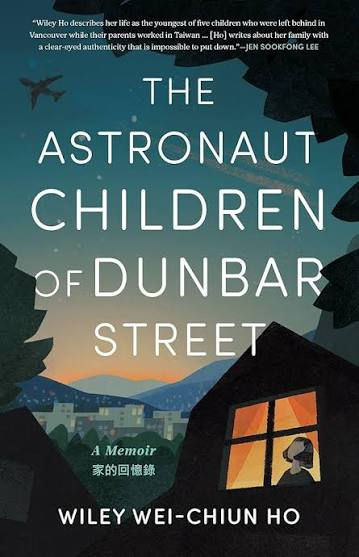
Reviewed by Wayne Ng
“When people ask about my childhood, the airport is what comes to mind.”
It is one of the most revealing lines in Wiley Wei-Chiun Ho’s The Astronaut Children of Dunbar Street, a memoir about migration, family, and the emotional costs of living between countries. The airport becomes a powerful metaphor for the childhood Ho describes: a life shaped by departures, temporary reunions, and the uncertainty of when loved ones will return. It is where the family’s transnational existence comes most clearly into focus—where anticipation and abandonment coexist, and love is measured as much by absence as by presence.
Readers of diaspora literature will expect certain familiar themes. But Ho’s memoir refuses to settle comfortably into the immigrant narrative. Instead, it complicates the genre by foregrounding a diasporic experience rarely explored with such emotional clarity: the astronaut family.
The memoir opens not with arrival in Canada, but with a return to Taiwan. Ho receives an urgent message from a sibling: “Baba is very sick and Ma has lost her mind. Hurry.” Her reluctance to go—“I don’t want to dredge up the past”—immediately establishes that this is not a sentimental homecoming. Returning means confronting a childhood shaped by parental absence, transnational separation, and the emotional debris left behind by a family stretched across continents.
Ho’s prose is crisp, observant, and often quietly devastating. During her pandemic quarantine in Taiwan, the present repeatedly collapses into memory. When she receives a Taiwanese passport forty years after leaving the country, the moment does not resolve her identity. Instead, it exposes its ambiguity. The passport feels both foreign and alive—a document that restores citizenship without restoring belonging.
This tension runs throughout the memoir. Ho writes about Taiwan’s political history—the White Terror, martial law, Cold War tensions—not as detached history but as the forces that shaped her parents’ choices and silences. She understands that the private lives of families are often inseparable from the political histories they inherit. Yet, she never allows history to overwhelm the domestic story. The book remains grounded in the intimate details of family: a mother packing a life into ten suitcases, socks hidden inside a rice cooker, the declaration that “Rice is home.”
Food, memory, and migration are familiar elements of diasporic writing, but Ho uses them without sentimentality. Her parents’ sacrifices are treated with tenderness, though never as an excuse for the harm their decisions caused. This is one of the memoir’s greatest strengths: its willingness to hold competing truths. Her parents left because they believed they had to. Their absence also wounded their children. Love and abandonment occupy the same space.
The “astronaut children” of the title are children whose parents return to Asia for work while they remain in North America. This reverses the familiar immigrant narrative. In many diasporic stories, parents and children migrate together, then struggle to bridge cultural and generational divides. Here, the children remain while the parents leave. The central rupture is not immigration but separation.
Ho’s childhood is shaped by globalization as much as migration—by economic opportunity, mobility, and the belief that a family can remain intact across oceans. The memoir exposes the emotional cost of that belief. Despite its difficult subject matter, the memoir is often funny. The story of Ho’s parents’ courtship is told with warmth and theatrical charm. Her father’s awkward declaration—“The moon sure is round tonight”—offers a moment of levity that reveals the book’s emotional range.
Ho reminds us that migration is not only trauma and loss. It is also absurdity, tenderness, family mythology, and the strange comedy of trying to understand the people who raised us.
The memoir’s episodic structure occasionally diffuses its momentum. Some chapters feel more like self-contained vignettes than fully developed essays. Yet, the fragmentation also reflects the life Ho describes: one marked by departures, interruptions, and conversations left unfinished.
Ultimately, The Astronaut Children of Dunbar Street is an act of reclamation. Ho is not simply reconstructing her family’s past; she is giving shape to experiences that were guarded by silence. The memoir expands Asian Canadian literature not because it abandons the traditions of diaspora, but because it reveals another way those traditions can be lived.
This is a story of leaving and returning, of parents and children caught in separate orbits, and of the gravitational pull that continues to draw families back together. Written with clarity, humour, and emotional precision, The Astronaut Children of Dunbar Street is a moving and unvarnished reckoning of what migration gives us—and what it asks us to leave behind.
The Astronaut Children of Dunbar Street is published by Douglas and McIntyre.
Wiley Ho will appear at LiterASIAN Ottawa at Perfect Books, September 29, 7 pm.
Comments